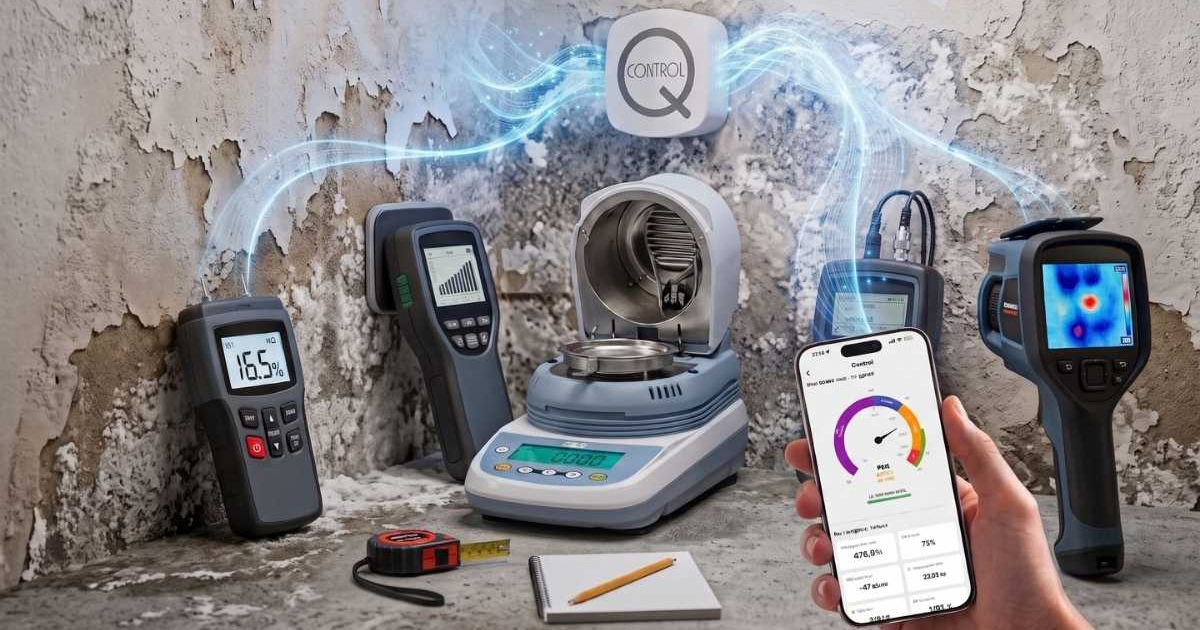
There are at least seven different methods for measuring moisture in construction materials, from industrial thermal cameras to laboratory-grade precision scales, and none of them is "the best" in absolute terms. The right choice depends on what you actually need: a quick inspection, a legally admissible number, or tracking a dehumidification process over months. That last one, tracking change over time, is what actually matters most, and it's what the fewest tools do well.
A problem as old as construction itself
In the earliest days of antiquity, after life in caves and nomadism, with the start of agriculture, human beings, feeling the need and having the ability to settle in areas of greater opportunity and wellbeing, formed the first human settlements: family groups, and later clans that benefited from unity for the common defense of their territory and their own vital safety against raids and unpredictable adverse events. First in makeshift shelters, then in huts and increasingly solid structures built to withstand violent attacks from animals or other people, building methods kept improving: first with natural materials like stone and wood, then with manufactured ones, using increasingly appropriate techniques to achieve materials that were both stronger and easier to handle, making use of abundant materials like clay and squared stone, eventually building the first structural dwellings, still rudimentary and without the ornamentation or comforts understood as such today.
Mud brick construction dates back roughly 9,000 years in the Middle East. From then on, buildings kept improving in structure and comfort as prosperity grew, and from that same point on, rising damp has bothered humanity's sense of comfort and hygiene.
Over the centuries, the home became, beyond a safe shelter, also a source of wellbeing, beauty, and comfort, in the pursuit of an ever more welcoming and representative dwelling.
As recently as 150 years ago, though, most people's homes still had packed-earth floors and unplastered walls: there wasn't even a need to care for or eliminate household moisture. But even the residences of the powerful and of royalty, with their "luxury" homes, had to submit to the cosmetic damage of rising damp with no remedy at all.
With the arrival and widespread use of ornamental techniques, paint, wall coverings, and flooring, humanity became more and more aware of just how adverse this scourge really was.
And so it remained until our own time: only in the last two decades did rational solutions to this hated phenomenon start being used.
Today, every home, even the most ordinary ones, has paint chosen in specific colors and textures, floors in fine woods, and the presence of mold, peeling paint, or lifted flooring has become absolutely intolerable. Today, controlling household moisture is necessary, unavoidable, and can't be put off.
Of all the types of moisture that can affect a property (roof leaks, side wall leaks, condensation, broken pipes), only rising damp was always considered unsolvable. Subfloors, flooring, and masonry structures had no way around this scourge in specific cases, until the arrival of dehumidifying devices that, using extremely low electromagnetic pulses, stop moisture from rising out of the ground into a building's structure.
From the very beginning, it became necessary to control, define, and standardize the correct identification, intensity, and progression of moisture using appropriate measuring instruments. The market offers a wide range of options, which we detail below by type, effectiveness, and practicality.
Measuring moisture is already half the battle
The market offers a wide range of instruments, each built for a different need. Before picking one, it's worth understanding what each type actually measures, and more importantly, what it can't tell you.
| # | Image | Type | Characteristics | Advantages | Disadvantages | Rating |
| 1 |  |
Thermal camera | High-tech tool for industrial inspections, thermal leaks, HVAC ducting | General overview of moisture in buildings | Not suited for precisely determining wall moisture; generic view, specialist use | ⭐️ |
| 2 |  |
Resistance-variation meter | Field meter, resistive type; measures resistance between two probes, better suited for wood | Practical, non-invasive, non-destructive, surface only | Only detects presence or absence of moisture, in wood | ⭐️ |
| 3 | 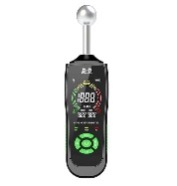 |
Field-variation meter (plate or ball) | Sends electromagnetic waves whose return signal is affected by moisture present | Practical, non-invasive, non-destructive, surface only | Only detects in clear-cut cases, presence or absence | ⭐️⭐️ |
| 4 | 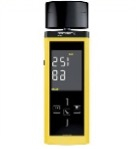 |
Microwave meter | Emits microwave radiation with a response at 2-3 cm depth | Practical, non-invasive, non-destructive, works below the surface | Detects presence or absence, not proportional to the actual moisture amount | ⭐️⭐️ |
| 5 |  |
Calcium carbide method (CM) | Regulated by UNI 11121:2004 (standard withdrawn April 2025); chemical reaction inside a sealed cylinder | Measurement proportional to moisture | Invasive and destructive, complex, high moisture loss during sample prep, low precision | ⭐️⭐️⭐️ |
| 6 | 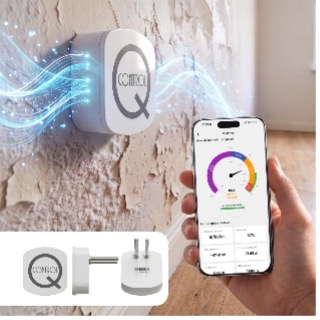 |
Resistive depth meter (Q Control, NovaTecnica) | Long probes (55 mm) measure resistance proportional to moisture; universal, portable, IoT-enabled | Innovative, standalone, pocket-sized, non-invasive, lets you set up fixed measurement points to track change over time | Measures moisture proportionally within a narrow value range; needs an internet connection | ⭐️⭐️⭐️⭐️⭐️ |
| 7 | 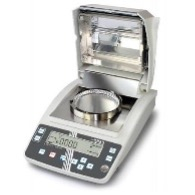 |
Gravimetric method (thermobalance) | Regulated by UNI 11085:2023; weighs the sample wet, then dried | The values closest to reality, of any method | Invasive and destructive, no second reading of the same sample | ⭐️⭐️⭐️⭐️⭐️ |
Which one to pick for which need
- Quick, low-commitment inspection: field meters (types 2, 3, or 4).
- A legally admissible number: the gravimetric method (type 7).
- Large-scale industrial diagnostics: thermal camera (type 1).
- Tracking a dehumidification process month to month: Q Control (type 6).
- Non-invasive mapping of historic buildings: Q Control (type 6).
What actually matters with each method
Type 1, the thermal camera, is a high-tech instrument with a high price tag (good professional units rarely cost less than $3,000), and it requires serious technical expertise. It's built for industrial settings handling high-pressure piping, boilers, or tanks. Using it on construction materials is forced, unnecessary, and imprecise.
Types 2, 3, and 4 simply detect whether a small area has moisture or not. These are the so-called "field" meters: easy, handy, fast, but useless for tracking how a problem evolves or calculating its real severity. They work as support tools alongside something more complete, not as a standalone solution.
Type 5, the calcium carbide method, was once regulated under Italian law (UNI 11121:2004), but due to its complex technical process, high invasiveness, destruction of the sampled area, and the imprecision caused by evaporation during sample prep, the standard was withdrawn in April 2025.
Type 6 is Q Control, a true breakthrough developed by NovaTecnica, a company specialized in treating rising damp. It's an essential tool for monitoring dehumidification, with a level of precision that, read correctly within narrow relative-humidity ranges, gives a clear picture of how severe a case really is. It's universal, easy to handle, measures just 8 cm, is portable, and thanks to its IoT technology lets you read multiple points in sequence. It works equally well for tracking moisture change inside a home and for professional mapping of historic buildings, since its readings are non-invasive, non-destructive, and repeatable as many times as needed at the same points. As of this writing, it's the only instrument on the world market with these characteristics, and given its precision and versatility, it probably won't stay unique for long.
Type 7, the gravimetric method, represents the highest precision achievable for determining relative humidity percentage. Regulated under European law (UNI 11085:2023), it's the only one recognized in legal disputes. But it's a bulky, invasive, destructive instrument: the tests aren't repeatable, and it demands extreme care when collecting the sample, since it's very easy for it to lose moisture during the process.
The conclusion almost nobody says out loud
Every relative-humidity percentage measurement in construction materials is affected, to some degree, by the presence of salts, differences in material grain size, internal voids, and other factors that can throw off the exact reading. That's why the most important question isn't absolute precision, which is nearly impossible to achieve with any instrument, but tracking the same points over time to assess severity and change.
Does it matter if relative humidity reads 7.1% instead of 6.6%? As devices that stop moisture from rising out of the ground become more and more widely used, what actually matters is tracking how moisture changes at the same points over time, not relying on destructive, single-use samples. Q Control is, without question, the best synthesis for this purpose: professionals and everyday users alike can have a precise, easy-to-read control instrument with one foot already in the future. It combines the ease of field meters (2, 3, and 4) with the precision of the more rigorous methods (5 and 7). That's the present, and the future, of moisture measurement in construction materials.
Frequently asked questions
What's the most accurate moisture meter?
The gravimetric method (thermobalance), regulated under UNI 11085:2023, is the most accurate and the only one recognized in legal disputes, but it's invasive, destructive, and doesn't allow a second reading of the same sample.
Do I need an internet connection to use Q Control?
Yes, Q Control uses IoT technology to transmit readings, so it needs an internet connection to work at full capacity.
Does a moisture meter tell me whether I have rising damp or condensation?
Not directly. A meter only confirms how much moisture is present at a point, not what's causing it. Telling rising damp apart from condensation or penetrating damp requires looking at the pattern (where it shows up, whether it depends on weather, whether there's efflorescence), not just the number the instrument gives you.
Why was the calcium carbide method's standard withdrawn in 2025?
Because even though it gave a measurement proportional to moisture, its high invasiveness, sample destruction, and the imprecision caused by evaporation during prep meant the Italian standard, UNI 11121:2004, was no longer considered reliable.
Is a field meter (type 2, 3, or 4) good enough to monitor a moisture treatment?
Not really. These instruments only detect presence or absence of moisture at a single moment, they don't allow reliable tracking of how a treatment progresses over several months.
If you're treating or monitoring rising damp, the question that actually matters isn't how exact one isolated number is, it's whether you can come back to the same point, month after month, confirm the devices in use are actually working, and trust what you see. Q Control is included with every Qiblí installation, and NovaTecnica has spent over a decade helping people monitor dehumidification with the same precision described here. See how Qiblí works or check the complete rising damp guide.