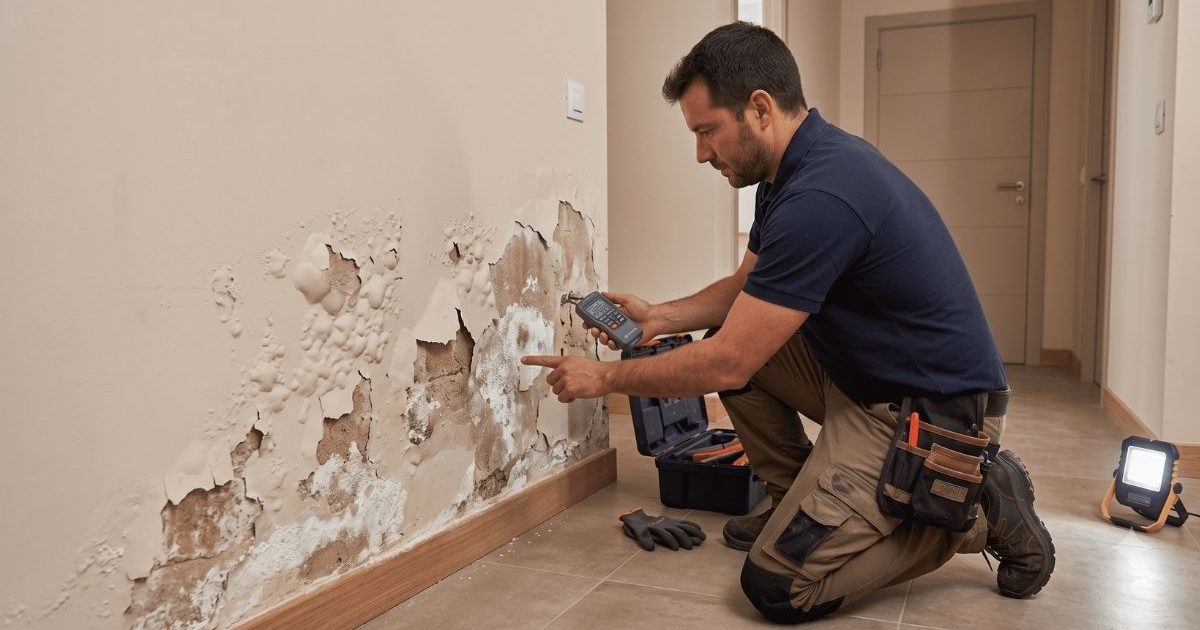
Rising damp is the process by which groundwater climbs through the pores of walls and floors up to the ground floor of a building. The main symptom isn't staining, it's paint or plaster that peels, bubbles, or breaks, along with salt deposits (efflorescence) on the surface. Staining and smell can show up in some cases, but those are secondary. It doesn't go away with fresh paint or new plaster. Only stopping the water rise at its source fixes it.
What exactly is rising damp?
When people talk about moisture in a house, most assume it's a single problem. In reality there are several types, and rising damp is one of the most persistent because it doesn't depend on weather or ventilation, but on a constant physical process. Groundwater is absorbed by porous building materials, such as brick, block, adobe, stone, or mortar, and climbs by capillary action, similar to how a paper towel absorbs water just by touching the surface of a glass.
Unlike a one-time leak or condensation from poor ventilation, this rise is a continuous process as long as the structure stays in contact with damp ground. That's why surface fixes, like waterproof paint, better ventilation, or dehumidifiers, help for a while but the problem comes back.
The electrical attraction that explains why it never stops at the wall
Here's something almost nobody knows, and it fully explains why repainting doesn't work: the process that pulls water up doesn't happen in the wall you can see, it happens at the foundation. Water carries a positive electrical charge, and building materials carry a negative one. That attraction between opposite charges is what pushes water upward, and it happens at the point of contact between the structure and the damp ground, not at the surface where you apply paint. As long as that attraction exists at the base, the water keeps climbing, no matter what you put on top of it.
Why some homes get it and others don't
Rising damp depends on a combination of factors:
- Proximity to groundwater or damp soil: the more water underground, the faster and higher it climbs.
- Porosity of the building material: adobe and handmade brick are especially vulnerable, dense concrete somewhat less so, but not immune.
- Whether there's a working damp proof course between the foundation and the wall: modern builds usually have one, older or historic buildings almost never do, or it has deteriorated.
- Age of the building itself, which explains why this shows up so often in older homes, historic buildings, and basements or ground floors.
The signs: how to recognize rising damp
These are the signs, ordered from most reliable to most occasional:
- Paint or plaster that bubbles, flakes, or lifts from the inside out (the main symptom).
- Efflorescence: a white, powdery crust that crumbles when touched (the second most reliable indicator).
- Visible staining low on the wall, typically 0 to 47 inches (0-120 cm) up from the floor (shows up in some cases, not all).
- A persistent musty smell, even in ventilated rooms (also a particular case, not the rule).
- Deteriorating baseboards, trim, or wood in contact with the affected area.
- Occasional electrical faults in outlets near the floor (lesser known, but real).
Why salt is the real reason paint breaks
As the water climbs, it carries dissolved mineral salts from the soil. Those salts build up inside the wall, sometimes for years, without showing on the surface. The problem shows up once they finally reach it: the water evaporates there, but the salt stays behind, and when it recrystallizes it can grow up to 300 times its original size, depending on the type of salt in the soil. That growth is what breaks the paint from the inside, literally pushing the material apart from within its own structure. That's why it doesn't matter how many coats you apply. If the underlying cause is still there, the result will be the same.
Rising damp vs. condensation vs. penetrating damp
This is the most common misdiagnosis. Treating condensation as if it were rising damp, or the other way around, makes any solution fail. This table sums up the key differences:
| Type of damp | Where it appears | Cause | Tell-tale sign |
| Rising damp | Low on ground-floor or basement walls | Groundwater rising through porous material | Efflorescence and peeling paint 0-47 in. (0-120 cm) high, present year-round |
| Condensation | Windows, cold corners, ceilings, bathrooms | Water vapor condensing on cold surfaces | Visible droplets, mold in corners/ceiling, no efflorescence |
| Penetrating damp | Roofs and exterior walls, worse after rain | Rainwater entering through cracks or failed waterproofing | Irregular patches that worsen with rain, not always at the base |
Still not sure which one you're dealing with? Use the quick self-diagnosis tool on our homepage.
Two common mistakes when trying to fix it yourself
The first one isn't anyone's fault. Not knowing it's salt, a lot of contractors assume it's mold and end up applying muriatic acid or even burning the wall trying to kill it. Not only does that do nothing, the problem stays exactly the same, or worse, because now there's chemical damage to deal with too.
The second mistake is covering the wall: tile, wood paneling, anything that hides the problem. It backfires. Sealing the surface doesn't stop the rise, the water finds another way out and climbs even higher, carrying more salt with it. It's common to see homes where someone covered the base of a wall years ago, and now the problem has shown up above that covering.
What happens if it's left untreated?
Rising damp doesn't stop on its own. The longer it's left, the higher the moisture line climbs, the more salt accumulates and crystallizes, degrading the finish from the inside, and the greater the risk of mold, with the respiratory effects that brings for anyone living or working in the building. In historic buildings or homes with wood framing, it can also compromise structural elements over time. The sooner the water rise is stopped, the lower the total cost, which includes both the treatment and the finish restoration.
Solutions for rising damp
There are several families of treatment, with different principles and levels of invasiveness:
- Physical damp proof course: cuts the wall horizontally and inserts a waterproof membrane. Effective, but highly invasive and costly.
- Chemical injection: uses a water-repellent resin to seal the material's pores. Requires drilling and careful technique for even penetration.
- Wired electroosmosis: installs electrodes across the wall, connected by cable to a control unit.
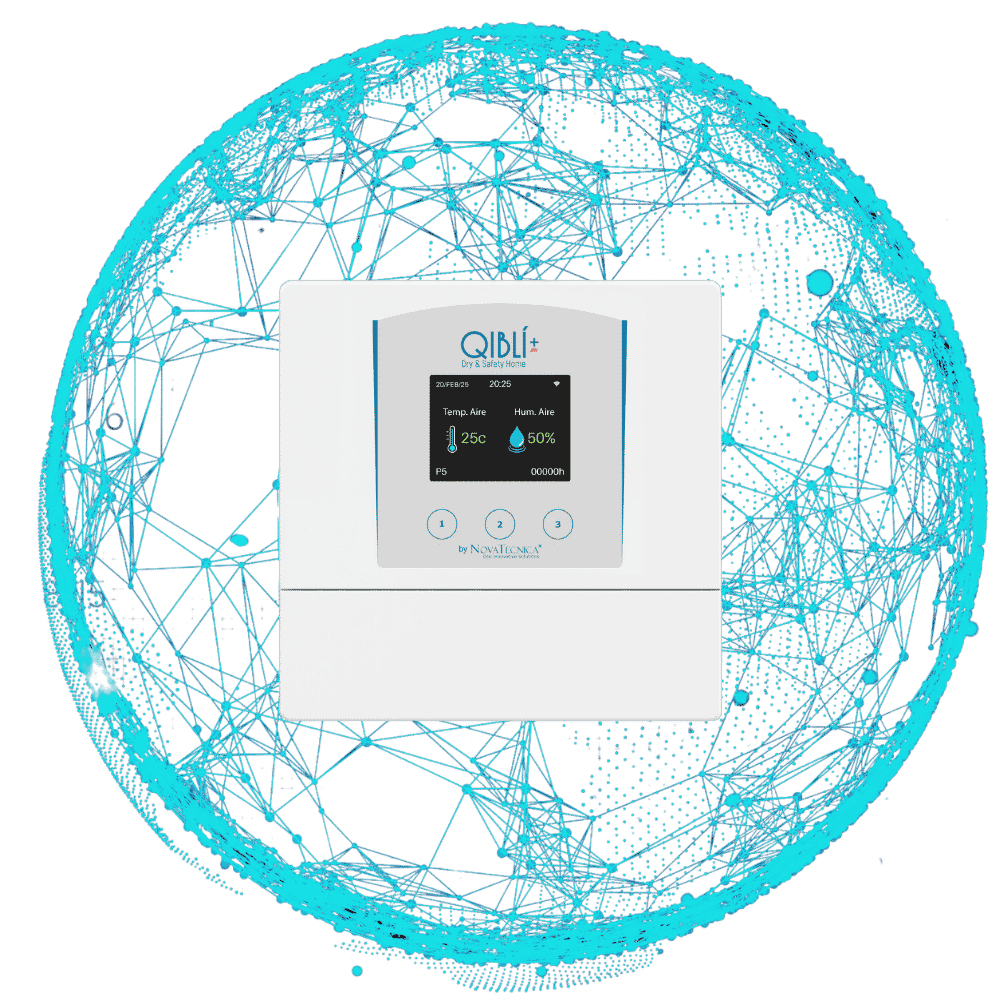
- Wireless electroosmosis: the same principle, but without cables or electrodes spread across the wall. A single device generates the field that does the work. This is the category Qiblí belongs to.
One important difference worth noting among all the methods mentioned is that only wireless electro-osmosis is capable of removing moisture from the entire structure, including the floor. With a device like Qiblí, it is possible to stop rising damp at its source—that is, at the foundation.
How Qiblí stops rising damp
Qiblí uses wireless electroosmosis: it generates a low-intensity electromagnetic field that travels through walls and floors and interacts with water molecules, stopping them from continuing to rise, without needing cables or wall-mounted electrodes. Its multi-frequency technology adapts to different building materials, like block, brick, adobe, or stone, and because there's no wiring involved, there's no construction, cutting, or injecting either.
It also includes IoT sensors (Q Control and Q Gas) that let you track drying progress and home safety from your phone. Qiblí is, in fact, the only device in the world that combines wireless electroosmosis with real-time moisture measurement, thanks to Q Control and NovaTecnica's dedicated mobile apps.
The process doesn't end once the water rise is stopped either. After that comes a step we at NovaTecnica call desalination, a restoration process focused specifically on removing the salt that already made it to the surface, without using chemicals that have nothing to do with the actual problem. Our after-sales team walks the contractor through that process directly, so the final finish doesn't get ruined by the same mistakes all over again. See the full breakdown on the Qiblí Plus product page.
Frequently asked questions about rising damp
Does waterproof paint solve the problem for good?
No. It can improve the look temporarily, but if water keeps rising from the foundation, salt keeps arriving and breaking the finish, no matter which paint you use.
How long does it take for a wall to dry out?
Once the water rise is stopped, natural drying takes between 6 and 36 months, depending on the material, ventilation, and temperature. Cosmetic restoration can often start sooner: at 6 months for block walls, 12 months for brick.
Is rising damp a health risk?
Indirectly, yes. The damp environment encourages mold growth, and mold spores can trigger respiratory issues, especially in children, older adults, or anyone with allergies.
Can it be treated without breaking into the walls?
Yes. Methods like wireless electroosmosis, Qiblí included, don't require cutting or injection, and can be installed without vacating the home.
Why did my contractor say it was mold?
It's a common mistake, not bad faith. A lot of contractors have never seen up close how salt behaves on a wall with rising damp, and at a glance it can look like mold. The main difference is that efflorescence is a white, powdery crust that crumbles when touched, while mold has a fuzzy or dark texture and usually smells musty.
What warranty does Qiblí come with?
Qiblí comes with a lifetime, unlimited warranty that covers both the electronic device and the dehumidification result, with no time limit. That's a meaningful difference from competitors, who typically offer limited warranties.
If you recognize these signs in your own home after reading this guide, the first step is confirming the diagnosis, then evaluating which solution fits your case. NovaTecnica has spent over a decade treating rising damp across Latin America, with more than 3,000 installations ranging from family homes to the Cathedral of Quito, backed by an after-sales team that stays with every case through the final restoration. See how Qiblí works or schedule an inspection for your specific case.