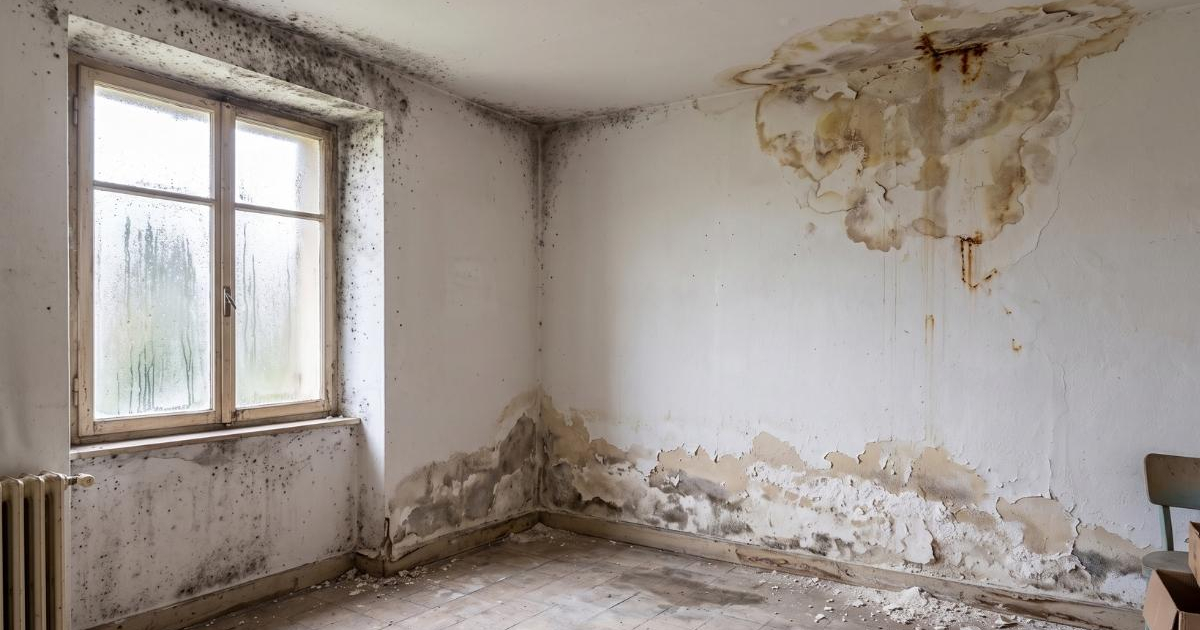
Three completely different problems cause damage on a wall, and most people treat them as if they were the same thing. Rising damp climbs from the ground, condensation forms from moisture in the air, and penetrating damp gets in through a gap in the roof or exterior waterproofing. Each has a different cause, so each needs a different fix. Treating one as if it were another doesn't solve anything.
Why they're so easy to mix up
All three can look similar at first glance: damp patches, damaged paint, sometimes a musty smell. But underneath that similar appearance are three completely different physical mechanisms, and each one responds to a different fix. Applying the wrong treatment doesn't just fail to solve the problem, it can mean spending money on something that was never going to work in the first place.
It's also common to see a wall with staining near the ceiling from a leak (penetrating damp) and efflorescence at the base from rising damp at the same time. If someone looks at the whole wall and concludes it's just "damp" without telling the two apart, it's easy to end up treating only one cause and being confused when the problem "doesn't fully go away."
Why each type leaves a different sign
The reason each type leaves a different mark comes down to how water moves in each case. With rising damp, water climbs while carrying dissolved salts from the soil, so wherever it evaporates, a mineral residue is left behind: efflorescence. Condensation involves no salts at all, because the water comes from the air, not the ground, so what's left is plain moisture that encourages mold, with no white residue. With penetrating damp, water enters with the force of rain and follows the path of least resistance inside the structure, which is why the patches are irregular instead of forming an even band like rising damp does.
| Rising damp | Condensation | Penetrating damp | |
| Cause | Groundwater climbing through the pores of the building | Water vapor in the air condensing on a cold surface | Rainwater entering through cracks or failed waterproofing |
| Where it appears | Low on ground-floor or basement walls | Windows, cold corners, ceilings, bathrooms | Roofs and exterior walls, often near windows or cracks |
| Time of year | Present year-round, constant | Worsens in cold weather or poor ventilation | Worsens specifically after heavy rain |
| Tell-tale sign | Peeling paint plus efflorescence (white crust) | Visible droplets, mold in corners or ceiling | Irregular patches, sometimes ring-shaped |
| Fixed by | Stopping the capillary rise (barrier or electroosmosis) | Better ventilation, thermal insulation | Repairing the waterproofing or roof |
How to recognize rising damp
- Paint or plaster that peels, bubbles, or breaks (the main symptom).
- Efflorescence: a white crust that crumbles when touched.
- Present all year, regardless of season.
- Concentrated low on the wall, roughly 0 to 47 inches (0-120 cm) up.
- In particular cases, staining or a musty smell can also appear.
How to recognize condensation
- Visible droplets on windows or cold surfaces.
- Mold in corners, ceilings, or behind furniture pushed against a wall.
- Worsens in cold weather or with poor ventilation.
- No efflorescence.
- Usually concentrated in bathrooms and kitchens.
How to recognize penetrating damp
- Irregular patches, sometimes ring-shaped.
- Shows up on ceilings or high on exterior walls.
- Clearly worsens right after heavy rain.
- May come with a visible active leak.
A quick self-diagnosis
If you're not sure, ask these questions in order. Does the damp only show up in cold weather or a poorly ventilated room? That's probably condensation. Does it get worse right after it rains, near the roof or a window? That's probably penetrating damp. Is it always there, low on the wall, regardless of the weather, with a white crust? That's rising damp.
Still not sure? Check the height. Rising damp almost never climbs higher than about 47 inches (120 cm) from the floor, because that's roughly as far as capillary action can carry water before it evaporates. If the damage is high on the wall or on the ceiling, rising damp is essentially ruled out, and it's down to condensation or penetrating damp.
Why treating one as another doesn't work
This is the most common misdiagnosis, and the one that wastes the most money. Better ventilation or thermal insulation does nothing against rising damp, because the water keeps climbing from the ground no matter how much you ventilate. In the same way, stopping the capillary rise with electroosmosis won't fix condensation, because there the problem is water vapor in the air, not groundwater. The first step is always confirming which of the three you have, and only then choosing the treatment.
A common version of this mistake: someone notices damp at the base of an older wall, assumes it's just poor airflow, and invests in extractor fans and better ventilation. Months later the wall looks exactly the same, because the problem was never the ambient air. They end up paying twice: once for the wrong fix, and again for the right one.
How Qiblí solves rising damp
If you've confirmed your case is rising damp, Qiblí uses wireless electroosmosis to stop the water rise without cables or construction work. See the full breakdown in the complete rising damp guide or the solutions comparison.
Frequently asked questions
Can I have more than one type of moisture at the same time?
Yes, it's more common than it sounds. An older home can have rising damp at the base and condensation in the bathroom at the same time. Each needs its own diagnosis and its own treatment.
Can a technician confirm the diagnosis if I'm not sure?
Yes, and it's the safest option if the signs aren't clear. A wrong diagnosis means paying for a treatment that was never going to work.
Does waterproof paint work for all three?
Not permanently, for any of them. In all three cases, it covers the symptom for a while, but if the actual cause isn't fixed, the water rise, the unventilated vapor, or the leak, the problem comes back.
Can penetrating damp be mistaken for rising damp on a ground floor?
It's possible, especially if the leak comes from a broken pipe under the floor. The pattern is the difference: penetrating damp tends to be irregular and tied to an event like rain or a leak, while rising damp is constant and always in that same low band on the wall.
What happens if I treat condensation as if it were rising damp?
You'll install a system that doesn't address the real cause, water vapor in the air, so the problem stays exactly the same, except now you've also paid for a treatment that never applied.
Why does a wall sometimes have two types of moisture at once?
Because each mechanism depends on a different condition, and nothing stops both from occurring in the same building. An older home near the water table, with poor bathroom ventilation, can have rising damp across the whole ground floor and condensation specifically in the bathroom, with no relationship between the two.
Does the season I check the wall in change the diagnosis?
Yes, and it's one of the most reliable clues. If you check during the dry season and the damp is just as present, that's a strong sign of rising damp, since it doesn't depend on weather. If it clearly improves in summer or with more ventilation, condensation becomes more likely.
Confirming which of the three types of moisture you have is the single step that saves the most time and money down the line. If you've confirmed it's rising damp, NovaTecnica has been treating it for over a decade, with more than 3,000 installations and a lifetime warranty on both the device and the result. See how Qiblí works or check the complete guide to confirm your diagnosis.